The Justice League of healthcare: Why ADLs are our superpower
If you’ve worked bedside or in rehab for more than a minute—nursing, OT, PT, SLP—you already know the truth:
Everybody needs a shower.
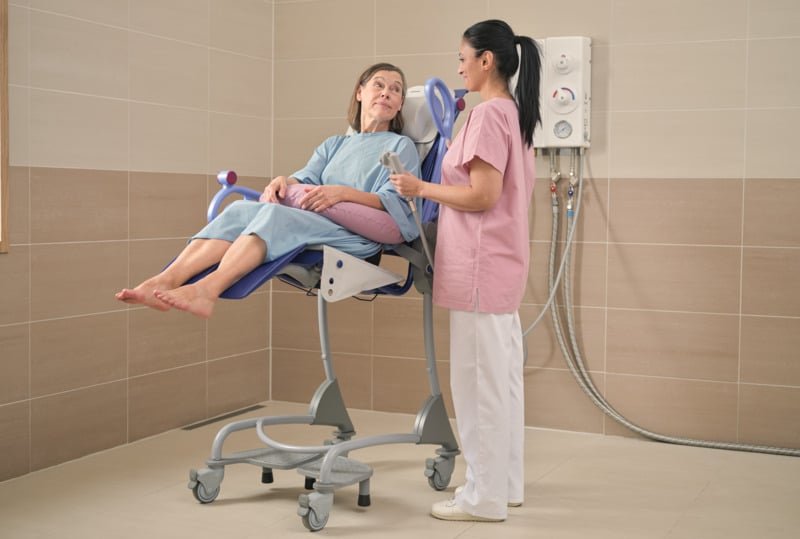
Across ICU, Med-Surg, Neuro, Tele, long-term care, and rehab settings, one thing doesn’t change: patients need help with the basics. Bathing. Toileting. Grooming. Skin care.
We call them Activities of Daily Living—ADLs.
And they’re not basic. They're medically necessary.
Even Florence Nightingale built modern care around them.
ADLs are clinical care
For nurses and therapy professionals, ADLs aren’t tasks to “get through.” They’re where the real assessment and intervention happen.
A bath isn’t just hygiene—it’s:
- A full skin assessment
- A neuro check in motion
- A mobility screen
- A chance to evaluate pain, balance, endurance, cognition
Grooming becomes fine motor work.
Toileting becomes transfer training.
Standing at the sink becomes early mobility.
This is interdisciplinary care at its best—without needing a formal consult.
Dignity is the outcome
We talk about outcomes in metrics. Length of stay. Readmission rates. Functional scores.
But there’s another outcome we don’t chart nearly enough:
Dignity.
The patient who can brush their own teeth again.
Stand for 15 seconds longer today than yesterday.
Wash their face without assistance.
These aren’t small wins. They’re identity-level victories.
ADLs restore autonomy—one repetition at a time.
Clean. Dry. Intact. Still the gold standard
We all learned it. We all say it. But it’s worth repeating because it drives everything.
Cleanliness reduces infection risk—C. diff, E. coli, Norovirus.
Dry skin prevents breakdown—yeast, dermatitis, pressure injuries, UTIs.
For high-risk populations, especially diabetics or immobile patients, this is limb- and life-saving care.
Clean + dry = intact.
Intact = fewer complications, better outcomes, preserved dignity.
The physical cost we don’t talk about enough
Let’s be honest—this work is physically demanding.
Repositioning. Transfers. Bathing dependent patients at odd hours. Managing lines, drains, confusion, resistance.
We’ve all had that moment—mid-transfer—where you feel your back remind you this is not sustainable.
And yet, the culture still whispers:
“Just get it done.”
It’s time to retire “just muscle through it”
Safe Patient Handling and Mobility (SPHM) isn’t about convenience—it’s about longevity.
For our patients. And for us.
The old habits—manual lifts, rushed pivots, skipping equipment—don’t make us efficient. They make us injured.
Protecting ourselves isn’t a luxury. It’s part of professional practice.
When tools support the team
A 2024 doctoral capstone by Bonnie Lei (UNLV) looked at training interdisciplinary teams—OT, PT, OTA, PTA, SLP—when utilizing the Sara® Combilizer to facilitate gains in:
- Grooming tasks in upright positions
- Early mobility in ICU-level patients
- Safer transfers with less strain
The impact of training was clear:
- Knowledge ↑ 27–30%1
- Understanding ↑ 18–22%1
- Confidence ↑ 21–26%1
- Overall performance ↑ 25%1
We know early mobility works. The barrier isn’t belief—it’s access, training, and habit.
Final word
ADLs aren’t the “extra” work. They are the work.
They’re where nursing and therapy intersect.
Where prevention meets recovery.
Where dignity is either preserved—or quietly lost.
Do them well, and everything improves: outcomes, safety, patient experience.
Ignore them, and everything downstream gets harder.
We don’t need capes.
Just the right mindset, the right support, and the willingness to do the fundamentals exceptionally well—every single time.
Reference:
- Lei, Bonnie, "Interdisciplinary Education on Using the Combilizer For Grooming Tasks in the Intensive Care Unit" (2024). UNLV Theses, Dissertations, Professional Papers, and Capstones. 5027. http://dx.doi.org/10.34917/37650851