Building sustainability into safe patient handling & mobility programs (SPHM)
Often when executing a safe patient handling & mobility (SPHM) program, safety is the key driver for success. This approach promotes the use of a device during patient transfers to ensure the safety of both the patient and staff.
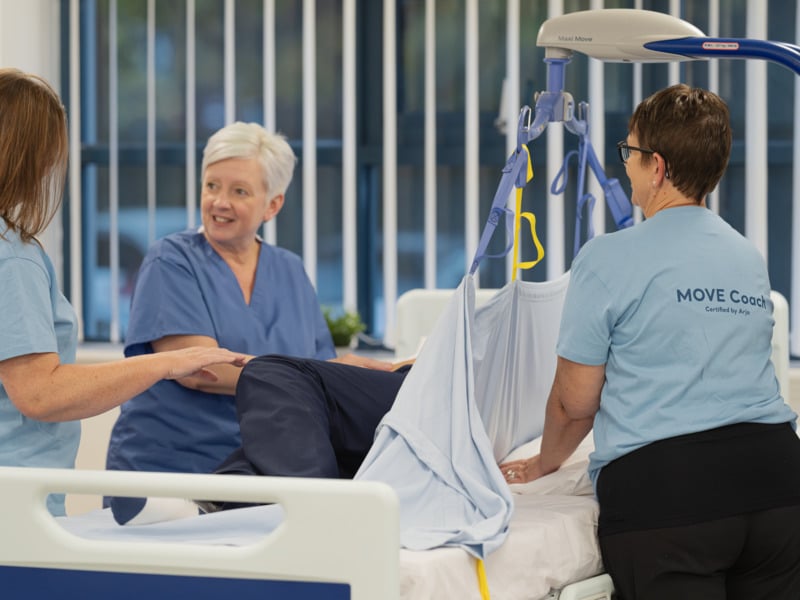
This thought process makes sense, unfortunately, the choice to use a device can be overruled by many factors. These factors include:
- Believing patients are “light” unless they weigh over 200 lbs
- Use of SPHM devices do not allow patients to participate in their own care
- Use of SPHM takes too long
- As well as many others
A more improved approach is to consider moving a patient as a clinical decision. Upon assessment of a patient, clinical triggers are identified. Based on the clinical trigger a treatment plan is developed. That treatment plan then drives the intervention. For example, upon patient assessment, a poor Braden Score is determined. The patient is at risk for a pressure injury. The treatment plan will now dictate an intervention of turning every two hours. In addition, to turning the patient a directive is given as to what device to use (for example, a repositioning sheet with ceiling lift). By following the treatment plan (to turn patient every 2-hours with a repositioning sling) the patient is moved in the most clinically appropriate manner (engineering out risk associated to friction, sheer, moisture, etc.) and both the patient & staff are safe. The use of the treatment plan removes the optionality of not using the device, unless there is a clinical reason not to.
To create this type of culture, there can be many causes of constraint. To improve the performance of safe patient handling & mobility programs it is often effective to categorize constraints & solutions in one of five categories:
- Training - this is two-fold. First, how to manage the logistics the logistics of training, especially with the challenge of staff shortages. Second, how to ensure competence after training has been completed. This competence involves both use of devices and the processes which support them.
- Process - Processes are a linchpin for success. Processes direct activity. It is important that they are:
- Metric-oriented and valuable
- Monitored and reported
- Support the goals of the mobility program and the organization
- Identify succinctly peoples’ roles and responsibilities
- Resources - Do you have the correct tools available (i.e., mobility assessment, method to communicate success and messaging, etc.), are there mobility technology gaps placing staff and patient at risk, etc.
- Environment - Are there physical constraints creating obstacles (reduced access to technologies on the unit and in patients’ rooms, etc.)
- Culture - Is/Are there:
- A culture of optionality present (inconsistent use of mobility intervention based on mobility need)
- Clear elements to support Right & Just Culture philosophy (i.e., are there clear roles and responsibilities identified for those involved with the program)
- Is there living mythology driving decision making (i.e., belief a 100 lb patient is light, mobility technology can create passivity vs activation for a patient, feeling there is not enough time to utilize a mobility device when working with a patient, etc.)
- A means to celebrate bright spots and connect mobility success as mission moments
Through these categories we can begin to identify gaps and strengths within a patient handling mobility program regardless of its level of maturity.
Connecting the identification of constraints to actionable solutions is critical for success. While categorizing challenges into training, process, resources, environment, and culture helps organizations understand where gaps exist, the next step is implementing a structured approach that addresses these areas holistically. This is where a comprehensive framework becomes essential—one that not only provides tools and education but also embeds clinical decision-making into everyday practice. By aligning interventions with evidence-based protocols and fostering accountability, organizations can move beyond recognizing barriers to actively transforming their mobility programs into sustainable, outcome-driven initiatives.
How Arjo’s MOVE® program facilitates change
Building a sustainable mobility program requires more than equipment, it demands a structured, clinically driven approach supported by robust processes, training, and cultural alignment. Arjo's MOVE program is designed to address these very challenges by providing a comprehensive framework that integrates clinical decision-making, evidence-based protocols, and staff education. Arjo MOVE helps organizations identify gaps, implement standardized processes, and foster a culture of accountability and success. By leveraging Arjo MOVE, healthcare facilities can transform mobility programs from optional practices into essential components of patient care, ensuring improved outcomes, reduced risk, and long-term sustainability, guaranteed.
Download case studies
Grounded in clinical evidence and tailored to your facility’s data, the Arjo MOVE program supports high-quality care that enhances mobility, improves outcomes, boosts staff well-being, and optimizes both operations and financial performance.
Arjo MOVE - Guaranteed Outcomes Program
If you're interested in learning more about our Caregiver Injury Reduction, Pressure injury Prevention and/or our Falls Programs, we would be happy to support you with guaranteed results.