
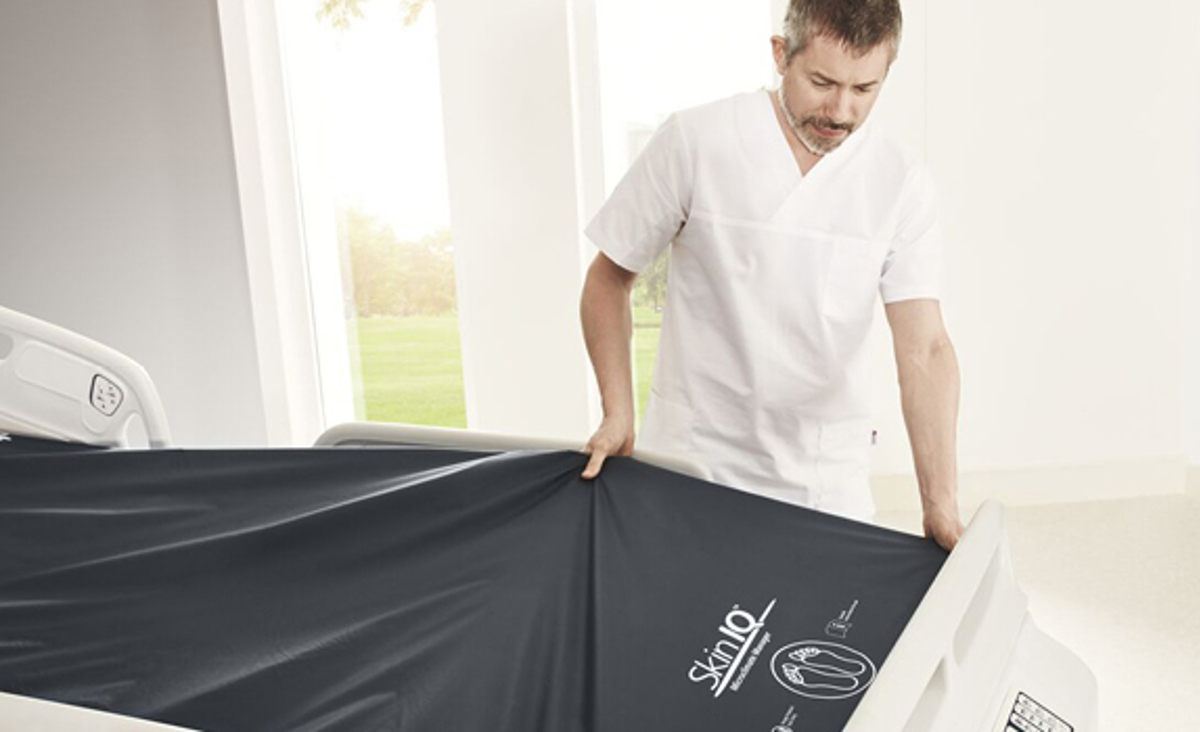
Microclimate management in Pressure Injury Prevention
Support surfaces are just one part of effective Pressure Injury Prevention. Managing microclimate, heat and moisture at the skin-surface interface, is another critical factor. Learn why it matters and how it can be addressed on our Microclimate Management page.
Learn from our experts

Understand the science behind your support surface
Download this in-depth clinical overview to explore the mechanisms behind pressure injury development and how support surface design, performance and testing can influence positive patient outcomes.
_Blog%20Image.jpg)
Make confident support surface choices
Make support surface selection straight forward and consistent. This easy-to-use guide helps you make informed decisions at the bedside, tailored to each patient’s individual needs. It offers a clear introduction to the key considerations involved in choosing the most appropriate support surface for every patient.

Practical insights for Pressure Injury Prevention
Gain practical, evidence-based guidance with our Arjo blog, covering key topics such as risk assessment, support surface selection and microclimate management.

Learn from the experts
Join our expert-led, on-demand webinars that explore a wide range of Pressure Injury
Prevention topics – and how these considerations come together in practice.

Your timely intervention is key
It takes just one risk factor for a pressure injury to develop. But with early intervention, it doesn’t have to.
Related content for our Pressure Injury Prevention category
Why is Microclimate Management important in Pressure Ulcer/Injury Prevention & Management?
by Sharon Maris, Director Global Medical Affairs for Pressure Injury Prevention Microclimate - the temperature and humidity at the skin’s surface - is a critical yet often underestimated factor in Pressure Ulcer/Injury Prevention. When heat and moisture build up, the skin becomes more fragile,...

Harnessing the power of intervention in pressure injury/ulcer prevention and management
by Sharon Maris, Director Global Medical Affairs for Pressure Injury Prevention Discover fresh insights from our clinical expert on the critical importance of early, individualised intervention in pressure injury prevention and management. Explore how the latest evidence-based guidelines,...

The power of intervention in pressure injury prevention and management
by Sharon Maris, Director Global Medical Affairs for Pressure Injury Prevention Pressure injury prevention interventions are key to reducing the risk of developing painful, resource intensive and costly pressure injuries.

Preventing Pressure Injury in Prone Positioning
Prone positioning, which involves turning a patient over so that they lie in a chest-down, is a well-established intervention for ARDS. It has been shown to improve oxygenation and prevent ventilator-induced lung injury due to the more uniform distribution of lung stress and strain1,2.

How our cover fabrics are designed to support infection control
A mattress cover should support the prevention of cross-contamination – without compromising the performance of the support surface.
_2%20Column%20Midsize%20Editorial.jpg)
The time factor in Alternating Pressure
Why “Lower for Longer” is the driving principle behind the performance of an Alternating Pressure surface.
_2%20Column%20Midsize%20Editorial.jpg)
What could a One Surface Strategy mean for you?
From the time PI risk is assessed to ensuring the appropriate intervention, time can be a crucial factor in improving outcomes for caregivers and those in their care.
_2%20Column%20Midsize%20Editorial.jpg)
How to prevent pressure injury during patient rehabilitation
Empowering movement is fundamental to any patient rehabilitation programme and is a core principle in the prevention of pressure injury development. With the impact of the current pandemic, the focus on mobilising and rehabilitating patients earlier and often throughout the day has never been higher...

Meeting the infection control challenge when selecting a support surface
Healthcare settings face the challenge of managing an effective Infection Control protocol on a daily basis. Ensuring the safety of patients and staff at all times, in a range of different settings requires a robust process, where care and treatment can be delivered without the risk of infection due...

Preventing Pressure Injuries in Patients with Reduced Mobility
Reduced mobility is a significant risk factor for pressure injury development, international guidelines emphasise the need for regular turning and repositioning of patients to help prevent skin damage¹. While a pressure redistribution mattress may enable the repositioning regimen to be...

How to manage microclimate in the plus sized patient?
According to a 2016 report by the WHO, globally there are 650 million people that are obese accounting for approx. 13% of the world’s adult population¹.

Managing skin microclimate with Skin IQ's Negative Airflow Technology
The International Pressure Ulcer Prevention and Management Guidelines discuss how managing microclimate can provide an environment conducive to injury prevention and tissue repair. As such the guidelines recommend the need for additional features such as the ability to control moisture and...
_2%20Column%20Midsize%20Editorial.jpg)
Informed Clinical Decision Making: An Introductory Exploration of the Repositioning and Full Body Support Surface Chapters from the Pressure Injury/Ulcer Prevention and Treatment Guidelines 2025
Since 2009, the Prevention and Treatment of Pressure Ulcers/Injuries: Clinical Practice Guideline has been collaboratively developed by the European Pressure Ulcer Advisory Panel (EPUAP), the National Pressure Injury Advisory Panel (NPIAP), and the Pan Pacific Pressure Injury Alliance (PPPIA), in...

An Individualised Approach to Support Surface Selection
Earn While You Learn: Continuing Education Certificate and One (1) Contact Hour Available! In part one of this three-part series, we explored how support surface technology may be used as part of a pressure injury/ulcer strategy, including core performance characteristics and testing associated with...

The Pressure Injury/Pressure Ulcer (PI/PU) Prevention Maze: Navigating the Role of Support Surface Technology
Earn While You Learn: Continuing Education Certificate and One (1) Contact Hour Available! Pressure injuries or pressure ulcers (PI/PU) significantly impact millions globally, especially those who are immobile or have compromised health. These conditions can cause severe pain, complications, and...

Pressure Injury/Ulcer Prevention: Understanding the Science of Support Surfaces
Join our webinar on Thursday, May 30, at 4pm CEST, 9am CDT, 10am EDT. Earn While You Learn: Continuing Education Certificate and One (1) Contact Hour Available! Learning objectives Report increased knowledge of the design and construction features, as well as the capabilities, of a full-body...

Empowering Movement: Improving Outcomes with an Integrated Approach to Pressure Ulcer/Injury Prevention
Pressure ulcer or pressure injury affects thousands of lives and is a major for any healthcare providers. With an increasing complexity posed by the COVID-19, on patients and residents and new guidelines released, Arjo is welcoming you to join Jacqui Fletcher OBE - Independent Wound Care Consultant,...

No matter the size…Body fold management is for everyone
Arjo, together with Nancy Morgan RN, BSN, MBA, WOC an experienced clinician, successful business leader, and accomplished educator in the field of wound management - invites you to this educational webinar. Body Fold management is for everybody from babies to seniors. We will review various skin...

Patient Handling Principles in Pressure Injury Prevention
Arjo is inviting you to join Jacqui Fletcher - a Senior Nurse Advisor at the Stop Pressure Ulcers Programme / Clinical Lead Pressure Ulcers National Wound Care Strategy to learn more about: the new perspectives on pressure ulcer/injury development and the damage cascade the leading factors which...

Pressure ulcer/Injury prevention in the ICU: Prone procedures protecting skin integrity; lessons learned during COVID 19
Arjo is inviting you to join Jacqui Fletcher - a senior nurse advisor and Robert Gannon - a nurse consultant as they discuss and dig deep into the clinical challenges of pressure ulcer/injury prevention and management during the COVID 19 pandemic with a specific emphasis placed on prone positioning...

Reducing the risk of pressure injury and caregiver injury during prone positioning
Arjo, together with Dr. Joyce Black and Dr. Stephen Wanless - researchers and professionals in the field of pressure injury, critical care medicine, and clinical bio-mechanics, invites you to discuss how to reduce the risk of pressure injuries for patients and help to avoid work related injuries for...

Skin microclimate and pressure ulcer/injury prevention
Arjo is welcoming you to join Professor Jan Kottner and the Skin microclimate and pressure ulcer/injury prevention webinar. Professor Jan Kottner works at the Charité Universitaetsmedizin Berlin. His key research interests are skin and tissue integrity and preventive skin care with a special focus...

Support Surface Standards Testing & Clinical Decision Making
Arjo is inviting you to join Evan Call - an experienced Medical Device Test and Development Specialist and Research Scientist to : Discuss the challenge in making sure the right patient receives the right support surface at the right time, and how the use of empirical performance data can help to...

Support Surface Standards Testing: Evaluating devices left in place
Arjo is inviting you to join Evan Call - an experienced Medical Device Test and Development Specialist and Research Scientist as he takes us through: The synergies between having a good surface and a suitable device left insitu – breathability, ability to handle temperature and moisture, supporting...
