Reprocessing: A strategic driver of more efficient and sustainable healthcare
Healthcare providers face increasing pressure to do more with less: managing rising costs, reducing environmental impact, and navigating ongoing supply chain uncertainty. Medical reprocessing offers a practical way to address all three challenges simultaneously.
Today’s healthcare systems largely operate on a linear model where products are manufactured, used once, and discarded. While this model has historically shaped how healthcare systems operate, it now comes at a growing cost. Linear operations drive high expenses, generate significant waste and emissions, and expose providers to supply chain vulnerability.
This model is increasingly unsustainable. Healthcare is among the most resource-intensive sectors, and single-use consumption patterns contribute heavily to both operational costs and environmental impact, with over 6 million tons of waste generated yearly¹.
As healthcare organizations look for ways to maximize value from existing products and materials, circular models such as reprocessing medical consumables and products can unlock benefits far beyond waste reduction.
“A shift toward circular operations has the potential to redefine what efficiency and sustainability in healthcare look like. By keeping products and materials in use longer through reuse, refurbishment, and recycling, healthcare providers can unlock new levels of efficiency while reducing their environmental footprint and strengthening supply continuity,” says Hailey Hotaki, Vice President of Corporate Affairs, Arjo US.
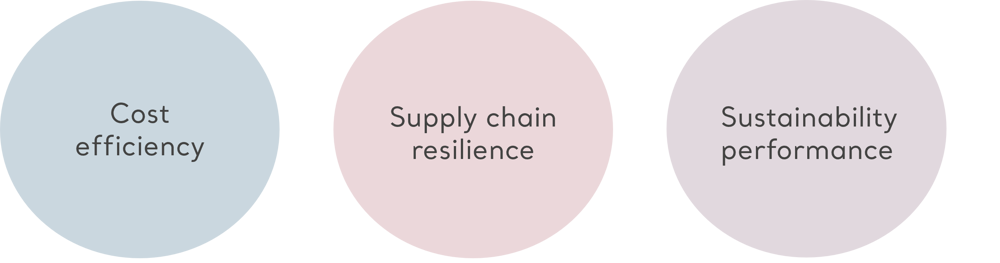
How reprocessing creates value for healthcare.
Delivering measurable financial and operational impact
One of the most immediate benefits of reprocessing is its impact on cost efficiency. By extending the life of medical devices and reducing reliance on new purchases, healthcare providers can achieve substantial cost savings compared to buying new products.
“Beyond procurement savings, reprocessing also reduces waste management costs and optimizes inventory flows. Structured collection, traceability systems, and data-driven logistics improve operational transparency and efficiency, enabling providers to better manage resources at scale,” says Hailey Hotaki.
Strengthening supply chain resilience
Recent global disruptions have highlighted the fragility of healthcare supply chains. Dependence on continuous manufacturing and long-distance logistics creates risk, particularly in times of crisis. Against this backdrop, reprocessing can help healthcare providers reduce exposure to supply shortages while building greater continuity and predictability into their operations.
“Reprocessing introduces a decentralized, circular supply loop that keeps critical products in circulation for longer, reducing dependence on external supply and mitigating shortages. By extending product lifecycles, healthcare systems can build a more stable and predictable supply base,” says Hailey Hotaki.
Accelerating healthcare’s sustainability transition
Healthcare is responsible for a substantial share of global emissions and waste, making decarbonization and resource efficiency urgent priorities. Reprocessing offers a high-impact, immediately actionable solution. By extending product life and reducing the need for new manufacturing, it can significantly lower environmental impact.
“Through our reprocessing program for garments used in the prevention of venous thromboembolism (VTE), product lifetimes can be extended up to nine times, reducing climate impact by up to 64% compared to single-use alternatives². In 2025 alone, we reprocessed nearly five million products, avoiding approximately 250 tons of emissions and diverting around 800 tons of waste from landfill,” says AJ Rajesh, Senior Manager, Technical Solutions & Sustainability at Arjo US.
These results illustrate how circular approaches generate environmental benefits and preserve product value for longer. When applied at scale, reprocessing can help care providers reduce resource consumption, lower emissions, and minimize waste while ensuring supply chain continuity.
As healthcare systems work to balance financial pressures, resilience requirements and sustainability commitments, circular models will become increasingly important. Reprocessing shows how environmental and operational goals can advance simultaneously. It offers a pathway to delivering better value from the resources already in use.
Discover how Arjo’s reprocessing solution helps care providers in their transition: Arjo ReNu | Arjo
References
¹ Bolton, A (2021) From Health Sector Waste Minimisation Towards a Circular Economy
² Life Cycle Assessment, “ReNu Medical LCA - Arjo DVT20”, 2023